When we talk about European BESS giants, we look at Germany, the United Kingdom, or Italy. But the real success story lies further east, in Bulgaria.
Three years ago, the country had almost no grid-scale storage. Today, it has more BESS capacity relative to its grid size than market giants like California, Germany, or even China. In the time it took to get there, it would have been impossible to build a coal or nuclear plant to support the grid.
The country is clear proof that storage can be built at the speed the energy transition needs when policy, the grid operator, and investors pull in the same direction.
Jump to:
How Bulgaria turned into a battery trailblazer
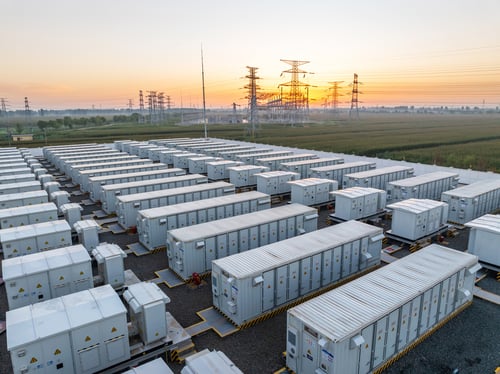
In 2025, Bulgaria added around 3 GWh of BESS, a 1,100% jump from the previous year, putting it third in the EU for new capacity, behind only Germany and Italy. By the end of August this year, its storage fleet had reached 6 GW/16 GWh, with storage accounting for more than 20% of the country's total installed power capacity. So how did Bulgaria achieve this feat, and what can other up-and-coming markets learn?
Policy that, for once, moved alongside the grid
Across Europe, grid connection queues that can stretch for months or years have become the bane of existence for BESS developers, while the network waits for upgrades.
Policy changes often move far slower than industries require. Bulgaria broke that pattern: the RESTORE programme channelled over €600 million from the EU's Recovery and Resilience Facility (RRF) into storage to subsidise up to 50% of project capacity. The hard RRF deadlines fast-tracked projects from decision to operation in about 18 months, roughly half the timeline we see in markets like Finland. Meanwhile, ESO, the Bulgarian TSO, processed around 12 GW of BESS connection applications, and gave storage a clear path onto the grid.
Other countries, like Greece, have so far limited government support to subsidies. Bulgaria shows these alone don’t launch projects: deadlines and a TSO that treats storage as part of the solution to grid challenges move the needle.
Batteries that earn across borders and flatten the duck curve
Bulgaria's solar boom has led to solar PV covering half of the country’s electricity needs and created a sharp duck curve that altered intraday price dynamics. The usual scenario played out: on especially sunny days, solar output dominates generation and pushes prices into the negatives by midday, before dropping at night and triggering price spikes. But while neighbouring countries are struggling with the same predicament, Bulgaria’s large influx of batteries helped flatten the curve.
Batteries charge on cheap midday solar, sometimes including imports from Greece and Romania, and discharge into the evening peak at home and across the border. Not only has this helped flatten the duck curve nationally, but Bulgaria’s BESS sector was also able to help other countries. This summer, when Greek midday prices turned negative, Bulgarian batteries absorbed the surplus and helped keep Greek evening peaks below €150/MWh.
Bulgaria is a textbook example of what a successful BESS development can look like: cross-border trading strengthens BESS’ economics, price spikes are softened for consumers, and solar’s business case is reinforced.
The untapped opportunity: ancillary services
Unlike many maturing BESS markets, most of Bulgaria’s BESS fleets earn solely from wholesale arbitrage and do not (yet) participate in the country’s ancillary services. While wholesale markets are a reliable revenue source for BESS, not participating in ancillary services means batteries leave additional revenue on the table and do not support the grid as efficiently as they should.
Batteries are built for the kind of fast and precise response ancillary services require, so an optimal strategy would be to co-optimise efficiently between wholesale and balancing markets. In addition, while wholesale markets are not prone to the same saturation issues as ancillary services, betting everything on arbitrage is also a mid-term vision.
The current arbitrage model, where batteries store electricity at cheap midday prices to sell it in the evening when prices rise sharply, will become harder as more and more batteries enter the market. As more competitors operate on the same model, the price-difference arbitrage it depends on will progressively erode.
For every market facing long connection queues or delays in operating licences, Bulgaria can be both a blueprint to learn from and a warning. Most markets require strategic and sophisticated multi-market optimisation and trading to make BESS projects profitable. Finding the right partners and the right commercial model will be the key differentiator.
Learn more about how Sympower is supporting Europe’s next wave of battery energy storage growth and how our services can help unlock long-term revenues for BESS projects.
This article was first published in our Energy Monthly newsletter. Subscribe to stay informed about our latest insights.

.jpg?length=500&name=iStock-2170896842%20(1).jpg) BESS6 October 2026
BESS6 October 2026.jpg?length=500&name=electric%20boiler%20(2).jpg) BESS6 October 2026
BESS6 October 2026 BESS6 October 2026
.jpg?length=500&name=electric%20boiler%20(1).jpg) BESS6 October 2026
BESS6 October 2026 BESS6 October 2026
 BESS6 October 2026
 BESS6 October 2026
 BESS6 October 2026
 BESS6 October 2026