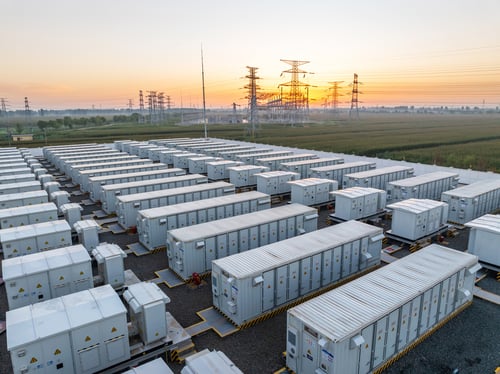
Growing electricity demand and renewable growth continue to drive long-term BESS needs. The current BESS market benefits from the surge in electricity demand and the associated storage needs, with electricity demand set to increase by as much as 50 percent in some European regions. This is matched by the growth of renewable electricity generation, which creates a long-term need for storage to mitigate the inherent volatility of wind and solar power.
According to Aurora Energy Research, Europe’s grid-scale BESS capacity is expected to expand fivefold to 55 GW by 2030 and reach 126 GW by 2050.. To avoid market saturation, BESS developers must diversify and optimise across balancing and wholesale services. With the right strategy in place, BESS portfolios can secure significant long-term revenue.
Jump to:
The importance of setting the right base for your BESS project
Purchasing equipment, securing land, and financing capital are some of the main focuses for developers when designing their BESS project. But a successful business case entails much more than these base costs.
A bankable and appealing business case for BESS requires operators to balance many cost factors with their earning potential. The most common upfront costs include:
- Battery System purchase price
- Land acquisition costs
- Inverter procurement costs
- Development of the land to prepare it for the plant installation
- Balance of the plant
- Grid Connection costs
- Equipment Procurement Costs
While these are typically front-of-mind when building a business case, other additional, ongoing costs must be carefully forecasted and analysed to secure long-term profitability. These are:
- Incurred fines and imbalances that may need to be paid throughout the BESS project, and can be hard to predict;
- Warranty, which may fluctuate up or down as the system is used more;
- Battery health and degradation: maintenance costs should be factored into each financial forecasting period;
- Grid costs and partner costs: either variable or fixed fees, depending on the type of grid connection and partner. Overall, this is where the business case can fluctuate the most and have the most impact on the differences between a high-cost and low-cost scenario.
Many of these ongoing costs can be fixed or variable, leaving the business case open to a wide range of variables and a significant disparity between low-cost and high-cost scenarios.
A well-designed business model will inform BESS project development, form a comprehensive analysis, and serve as an indicator of success, keeping projects on track.
One of the most commonly requested services Sympower provides to clients to help balance these costs and revenue opportunities is a revenue stack breakdown. This entails a comprehensive analysis of not just the gross revenue income, but also where revenue is coming from, which types of markets, and what the scenario would be if regulations change or a particular market disappears.
How to mitigate risks in your BESS project
Even with favourable macro drivers, four recurring risks require attention:
- Project set-up and strategy – Complex supplier chains can blur governance and delay fixes, harming ROI.
- Prequalifications – Every new service requires technical approval, which can be delayed by bottlenecks, postponing go-live dates, and impacting cash flow.
- Trading – Over-reliance on a single market or poor price insight limits captured revenue.
- Fleet operations – Inadequate monitoring hides technical issues, reduces availability, and locks out lucrative price spikes.
Sound planning and clear accountability help de-risk projects before they meet the market.
A checklist for BESS best practices
Implementing best practices at every stage of the business development process is essential, and includes:
| Project set-up & strategy |
Prequalifications |
Trading |
Fleet operations |
- Building and reviewing the business case every 6 to 9 months;
- Diversifying the portfolio to buffer market fluctuations;
- Establishing transparent governance and choosing partners wisely;
- Spreading project risk among all major stakeholders.
|
- Planning for complexity, building redundancy and back-up plans;
- Hiring specialists with proven TSO experience.
|
- Continuously stacking and refreshing revenue streams;
- Tracking asset performance and benchmark revenues;
- Focusing on net returns, not gross, after trading costs.
|
- Implementing a comprehensive alert chain for hardware, software and communications;
- Investing in advanced battery-health monitoring and preventative maintenance.
|
Each action can make a decisive difference to profitability and investor confidence.
How can Sympower help with your BESS project?
Sympower partners with battery-storage developers across Europe, guiding assets through connection, pre-qualification, and day-to-day dispatch. Our machine-learning platform trades across multiple power markets, maximising earnings while protecting battery health. To bolster investor confidence, we also offer a revenue guarantee product that underwrites part of the cash flow and enhances the overall bankability of large-scale BESS projects.
Looking for an independent, end-to-end route-to-market provider? Talk to our BESS experts today, and see how we can maximise your BESS project's lifespan and ROI.

 BESS20 August 2025
.jpg?length=500&name=iStock-2170896842%20(1).jpg) BESS20 August 2025
BESS20 August 2025.jpg?length=500&name=electric%20boiler%20(2).jpg) BESS20 August 2025
BESS20 August 2025 BESS20 August 2025
.jpg?length=500&name=electric%20boiler%20(1).jpg) BESS20 August 2025
BESS20 August 2025 BESS20 August 2025
 BESS20 August 2025
 BESS20 August 2025
 BESS20 August 2025