Beyond revenue potential: navigating the technical complexities of BESS optimisation
.jpg?width=1200&name=electric%20boiler%20(1).jpg)
As the BESS sector grows more competitive, developers face volatile energy markets, saturation risks, and rising pressure to secure long-term returns. The most costly mistake a BESS developer can make is focusing only on promised revenue while underestimating the technical and operational factors that can quietly erode profitability over time.
Continue reading this article to learn more about three areas that can damage your BESS project’s profitability, or watch the replay of our webinar “Revenue vs. Profitability: How to Avoid BESS ROI Pitfalls” by clicking on the image below.
.jpg?width=622&height=373&name=BESS%20Webinar%20-%20Optimising%20for%20flexibility%20-%20Cover%20(1).jpg)
Jump to:
- Understanding Network Charges and Grid Costs
- Navigating the complexities of pre-qualifying BESS
- Addressing imbalance costs
Understanding Network Charges and Grid Costs
Network charges, also known as DSO (Distribution System Operator) or TSO (Transmission System Operator) costs, are fees paid to access the grid that can significantly impact the business case for BESS projects. Taking them into account will also inform trading strategies and guide the steering of BESS assets.
They typically include a fixed charge (€/period), a capacity charge (€/kW/period) and a volumetric charge (€/kWh/period). The structure of these tariffs is designed to be cost-reflective and transparent, taking into account the need for network security and flexibility, and reflecting actual costs incurred.
Multiple factors need to be taken into account by BESS developers to optimise their projects, including:
- Significant regional variation in grid costs that can substantially affect the ROI of projects. In some cases, they can approach the value of the CAPEX repayment, eroding the project’s ROI.
- Which trade-off to make? There is always a discussion between upfront CAPEX and ongoing OPEX. DSO costs can be seen in a similar light, with some project sites having high land or grid connection costs but lower ongoing DSO costs. A lack of clarity on how these costs will evolve adds uncertainty. For example, in the Netherlands, the TSO Tennet has rapidly increased costs for high-voltage connections due to grid congestion.
- Conditional grid connections: DSOs may impose restrictions, such as limitations on hours of use or power capping at specific times of the year. This can impact the revenue potential for your project, but may also be a reasonable compromise to get the BESS project across the line.
Like PPAs and tolling contracts, off-market agreements could be developed between BESS operators and DSOs or Power-to-X companies. These would help DSOs manage their grids more effectively and alleviate congestion issues, while creating long-term, fixed revenue opportunities.
| Key takeaway: network costs can fundamentally impact the attractiveness of BESS projects. Anticipating fluctuations and identifying opportunities to collaborate with DSOs is essential to protect returns. |
Navigating the complexities of pre-qualifying BESS
While multi-market optimisation is essential for long-term profitability, a battery only earns once it’s live in the market. For that, it needs to overcome a significant hurdle: completing a pre-qualification with the Transmission System Operator (TSO).
Speed to market is everything. Each week a battery waits in the pre-qualification queue can result in up to 2% of annual revenue being lost. This process is more than a technical formality: it is one of the most critical steps, and often the most underestimated. Without an ironclad, structured process, weeks or even months can be lost to administrative delays, unclear requirements, and repeated test cycles.
During the pre-qualification stage, assets must prove their ability to meet the technical requirements of the desired ancillary markets. These requirements are set and enforced by the Transmission System Operator (TSO), which reviews the application, often over multiple rounds of follow-up tests. While the tests themselves usually take only a few days, administrative delays, unclear requirements, or poor TSO communication can stretch the process into weeks or months.
The challenge doesn’t end there, as pre-qualification is not a one-time hurdle. A new process is required whenever market rules change or when additional market programmes are added to the asset’s stack. In addition, the duration of the pre-qualification's validity is often shorter than the operational lifetime of the battery, and will have to be renewed. In Sweden, pre-qualifications are valid for up to five years.
Without a robust process and strong TSO relationships, each update risks further delays and lost revenue. That’s why partnering with a team that has deep pre-qualification experience and established TSO relationships is crucial. It’s the difference between stalled projects and smooth market entry.
To avoid costly delays, developers should look for partners with:
- Experience in project management, so they can coordinate with all parties involved, provide the hardware and software needed to perform necessary tests, and fully understand the project’s operational constraints.
- Pre-approved technical solutions and established good communications with the TSO. Their understanding of the TSO’s requirements and ready-to-use structured process to respond to feedback will help streamline the process.
- Strategic overview of the BESS project, and the ability to identify new opportunities.
| Key takeaway: pre-qualification is a required step to participate in ancillary markets. It is a time-consuming and complex process, with a high risk of entry delay. A partner with extensive experience can help avoid costly delays and accelerate market entry. |
Addressing imbalance costs
Imbalance costs are a significant concern in the Nordic markets, driven by unpredictable fluctuations in supply and demand. Imbalance occurs when there is a mismatch between the predicted and actual consumption or production. The integration of more wind and solar energy, along with increased consumption, exacerbates these imbalances.
Imbalance is notoriously difficult to predict and can often yield very different results under seemingly similar conditions. The graph below represents a real-life situation that happened in Finland. The top graph illustrates the degree of imbalance throughout the day.
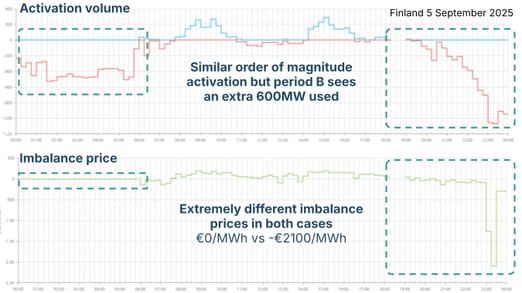
The red line illustrates a significant imbalance being captured by the mFRR down market, indicating that when excessive electricity is present in the market, the TSO activates mFRR to bring the frequency. A battery active in mFRR down will start to charge to consume that energy. Anything above the blue line is mFRR up, meaning that not enough energy is in the market, and the TSO will turn to someone else to cover the gap and produce.
In this scenario, we observe a prolonged period of down activation in the morning, at €0.
In this situation, the impact would be null, and renewable energy producers would be happy to shut down their production assets. The challenge arises in the afternoon and evening, when a second prolonged activation occurs, with the red line dropping significantly, reaching roughly 1.1 to 1.2 GW of mFRR down. In parallel, the imbalance price dropped all the way down to €-2,100 per megawatt-hour, meaning that an energy producer could receive a substantial fine if caught in this situation.
This particular situation illustrates how two similar imbalance events can have quite dramatically different results.
While the future trajectory of imbalance prices is uncertain, three trends are likely:
- The increase in wind and solar production will increase the imbalance and activations;
- The predicted increased bidding on the 15-minute intraday market will help more parties adjust their position and should help reduce imbalance overtime;
- A growing supply of flexible assets, including BESS on mFRR will dampen extreme price swings over time.
While we expect the volume of imbalance and activations to rise, the growing supply in balancing providers will reduce extreme price events.
| Key takeaway: imbalance costs are one of the key challenges facing the Nordic markets. Given the large amount of oncoming BESS and other flexible assets, it is likely that extreme imbalance prices will reduce over time. |
Navigating the complexities of the BESS sector requires a strategic approach to network charges, pre-qualification, and market imbalances. Reach out to our BESS experts to understand how we can leverage our experience and optimisation capabilities to guarantee long-term return on investment for your BESS project!
Other articles you might find interesting
-
.jpg?length=500&name=iStock-2170896842%20(1).jpg) BESS1 October 2025
BESS1 October 2025The Hidden Idle Asset Trap: a New Era of BESS Optimisation in Europe
Read more -
.jpg?length=500&name=electric%20boiler%20(2).jpg) BESS1 October 2025
BESS1 October 2025Australia’s Battery Blueprint: Lessons for Europe’s BESS Developers from a Global Market Leader
Read more -
 BESS1 October 2025
BESS Optimisation: Why 2-Hour Systems Make a Difference
Read more -
 BESS1 October 2025
Maximise Battery Revenue: How to Build a Successful Business Case
Read more -
 BESS1 October 2025
The Greek BESS Opportunity: One Market Won’t Do
Read more -
 BESS1 October 2025
Unlocking BESS’ Full Potential: Why Multi-Market Trading is the Future
Read more -
 BESS1 October 2025
Maximising BESS Earnings: 5 Key Revenue Models
Read more -
 BESS1 October 2025
Harnessing BESS’ Potential in the Nordics: Key Insights from our Webinar
Read more -
 BESS1 October 2025
What is Battery Storage?
Read more